

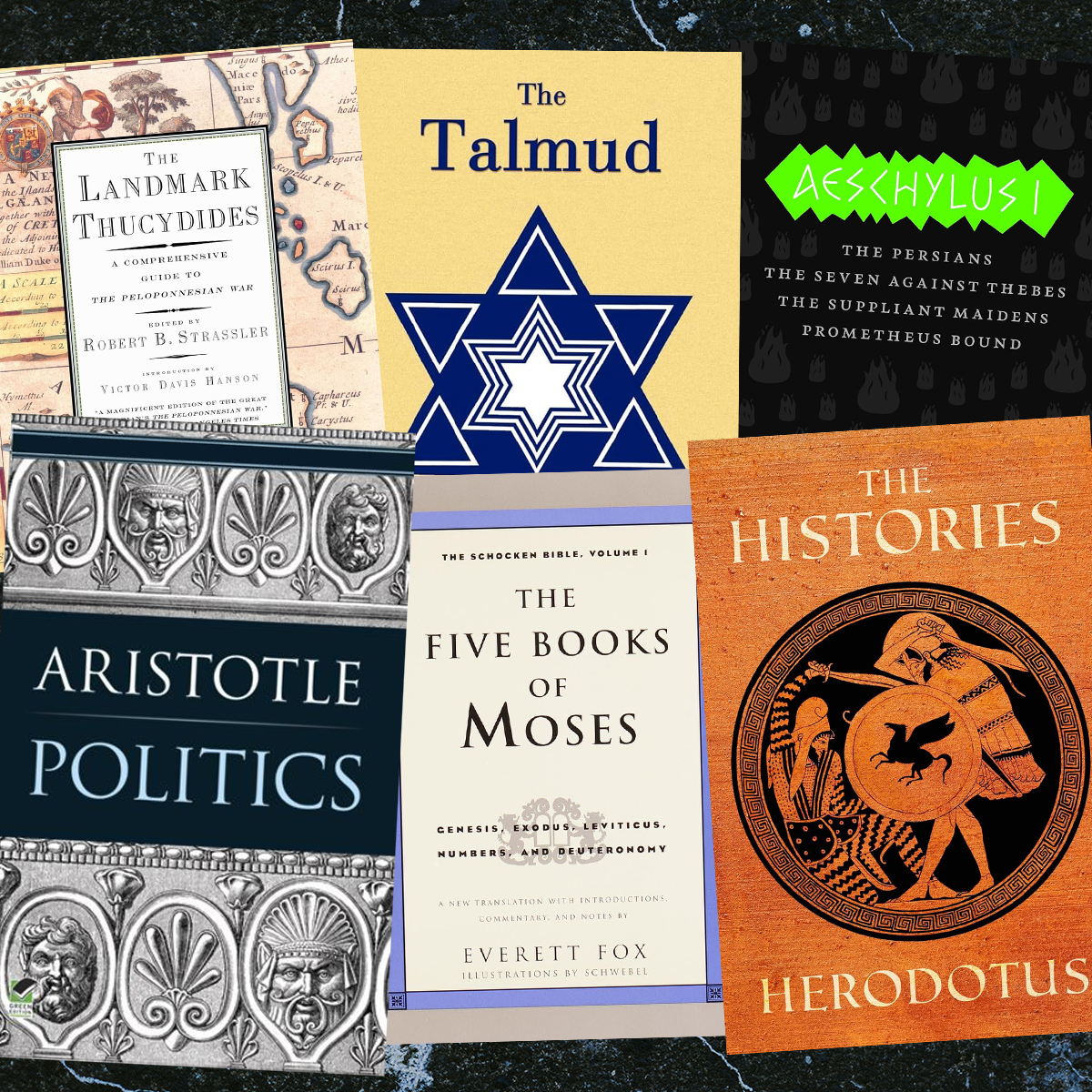
“The Beginning of Politics,” a required Intellectual Foundations course for all University of Austin undergraduates, is an introduction to the nature, meaning, and purposes of political life. Questions to be raised include: What is politics? Are human beings political animals? Does a city differ from a pack of wolves, a herd of sheep, or a band of robbers? What is law? Can it be said that some laws are better than others? What do Greek and biblical understandings of politics and leadership have in common?
Students will address these questions through the careful reading and discussion of classic texts in small seminars, supplemented by common Intellectual Foundations lectures.
Required Books:
Plato, The Republic of Plato, translated by Allan Bloom (Basic Books)
Thucydides, The Landmark Thucydides, edited by Robert Strassler (Free Press)
Aeschylus I (University of Chicago Press)
Aristotle, Nicomachean Ethics, translated by Bartlett and Collins (University of Chicago Press)
The Five Books of Moses, translated by Everett Fox (Schocken)
With selections from Aristotle’s Politics, Herodotus, the Book of Samuel, and Talmud Bava Metzia (“The Oven of Akhnai,” translated by Adin Steinsaltz)
Course Outcomes and Objectives:
Achieve a critical understanding of the nature, purposes, and preconditions of political community.
Students should be able to:
- Articulate the anthropological and theological foundations of Greek, barbarian, and biblical conceptions of politics, society, and the significance of speech (logos).
- Distinguish between Greek and biblical conceptions of happiness, and explain how each relates to politics, law, and human excellence.
- Identify fundamental points of agreement and disagreement between the Greek and biblical traditions regarding the nature and foundations of a political regime and the sources of political authority.
- Define and analyze the implications of tyranny and despotism.
Reflections: Once each week, students will select a short passage from the day’s reading—less than 100 words—that grabs their interest and unpack it in roughly 300-500 words. Some questions they might ponder: What is noteworthy, strange, or surprising about the chosen passage? How does it illuminate or connect with other parts of the text? What questions or issues worthy of discussion in class are prompted by the passage?
Electronics: Students may not use laptops, iPads, cellphones, or any other electronic devices during class.
Subscribe to our newsletter for program updates.